


Can You Get a DWI in New Jersey for Prescription Medication?
August 28, 2026
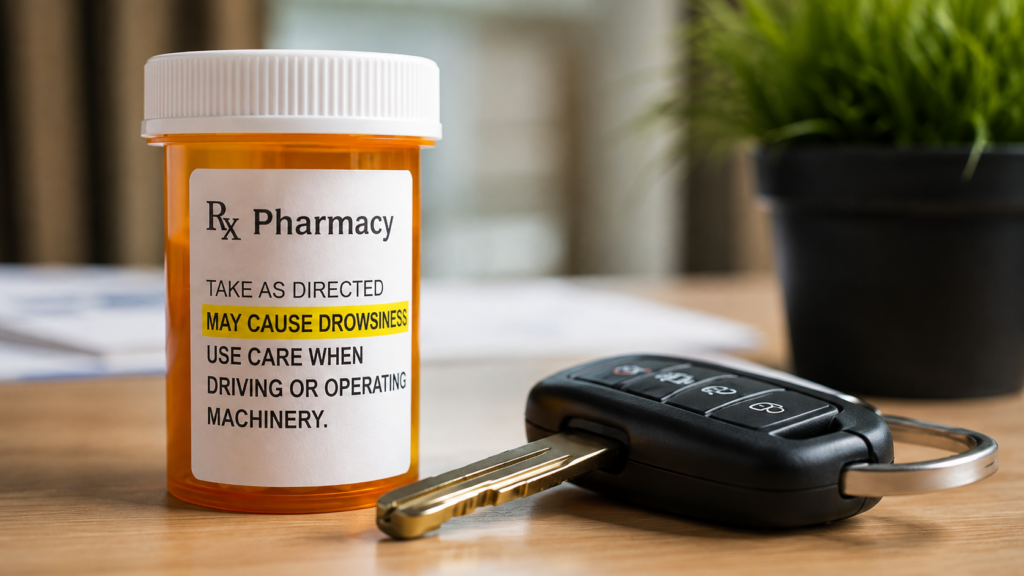
You took the medication your doctor prescribed. You were not drinking, and you were not using an illegal drug. Then, after a traffic stop, police began asking whether you had taken any medication before driving.
That situation can be confusing. If the medication was legally prescribed to you, can you really be charged with DWI?
Yes. In New Jersey, having a valid prescription does not automatically prevent a DWI charge if the State alleges that a medication or other drug covered by New Jersey’s DWI law impaired you while you were driving.
The important question is not simply whether you were legally allowed to take the medication. A prescription-drug DWI case focuses on whether you were under the influence while operating the vehicle and whether the State can prove that the alleged impairment was caused by a narcotic, hallucinogenic, or habit-producing drug within the meaning of New Jersey’s DWI law.
Does a Prescription Protect You From a DWI Charge?
No. A valid prescription explains why you were legally taking the medication, but it does not by itself determine whether you were driving under the influence.
Under N.J.S.A. 39:4-50, New Jersey prohibits operating a motor vehicle while under the influence of intoxicating liquor or a narcotic, hallucinogenic, or habit-producing drug. That means the legality of the prescription and the question of impairment are separate issues.
At the same time, taking prescribed medication does not automatically mean you were impaired. The State still has to prove the elements of the DWI charge beyond a reasonable doubt.
The fact that you were legally prescribed the medication is relevant, but it does not answer the impairment question. The focus is on what effect, if any, the medication had on you while you were operating the vehicle.
Why Does the Type of Prescription Medication Matter?
Not every prescription medication raises the same issues in a DWI investigation. The particular medication and the circumstances surrounding its use can matter when evaluating alleged impairment.
Relevant details can include the medication involved, dosage, when it was taken, whether the dosage recently changed, whether other substances were also taken, and what officers observed about the driver.
Police may focus on unusual driving, difficulty following instructions, balance or coordination problems, slowed responses, speech, drowsiness, pupil appearance, or other signs they associate with drug impairment.
Some medications also carry warnings about driving or operating machinery. A warning can be relevant to the circumstances, but it does not by itself establish that a particular driver was impaired at the time of the stop.
The issue has to be evaluated based on the medication involved and the evidence from the individual case.
How Is a Prescription-Drug DWI Different From an Alcohol DWI?
One important difference is that New Jersey does not have a numerical drug limit comparable to the BAC threshold used in alcohol DWI cases.
For alcohol, N.J.S.A. 39:4-50 establishes a per se DWI violation at a blood alcohol concentration of 0.08 percent or higher. For drug-impaired driving, there is no equivalent statutory concentration that automatically establishes a DWI violation.
That distinction matters when prescription medication is involved. A toxicology result showing that a drug was present can be important evidence, but the presence of a drug does not create the same type of per se violation as a BAC of 0.08 percent or higher.
Without an equivalent numerical drug threshold, the State’s case depends on the evidence showing whether the driver was impaired and whether drugs caused that impairment.
That makes the observations, testing, and other evidence gathered during the investigation especially important.
What Evidence Matters in a Prescription-Drug DWI Case?
A prescription-drug DWI case may not revolve around a breath-test number. Instead, several pieces of evidence can become important, including:
- why the vehicle was stopped
- observations about how the vehicle was being driven
- the driver’s speech, coordination, balance, attention, or behavior
- performance on field sobriety exercises
- statements about medications, alcohol, or other substances
- a Drug Recognition Expert evaluation
- toxicology results when available
- video or other evidence showing the driver’s condition during the encounter
Observations that someone appeared impaired can be important, but a drug-DWI case also raises the question of what caused that condition. A driver can appear tired, unsteady, confused, or have difficulty completing roadside exercises for reasons other than drug impairment.
That is why the evidence has to be considered together rather than assuming that one observation or test result answers the entire question.
What Is a Drug Recognition Expert?
Some drug-DWI investigations involve an officer trained as a Drug Recognition Expert, commonly called a DRE.
A DRE uses a standardized evaluation process that includes observations and examinations designed to help the officer assess whether a driver appears impaired by one or more categories of drugs. The process can include field sobriety testing, checks of vital signs and pupil responses, an interview, other physical observations, and toxicological testing.
The New Jersey Supreme Court has found DRE testimony sufficiently reliable to be admitted as expert evidence, subject to important limitations and safeguards. A DRE may testify that the evaluation produced signs consistent with the use of one or more categories of drugs, but the DRE may not simply conclude that those drugs actually caused the driver’s observed impairment.
Toxicology evidence can also be important. When feasible, the State must make a reasonable attempt to obtain a toxicology report based on a blood or urine sample. If the State does not make that reasonable attempt and lacks a persuasive justification, the DRE opinion testimony must be excluded.
How the evaluation was performed, whether toxicology testing was obtained or reasonably attempted, what the officer observed, and other possible explanations for the driver’s condition can all matter when the evidence is evaluated.
What If You Took the Medication Exactly as Prescribed?
Taking medication exactly as your doctor directed can be an important fact, but it does not automatically resolve a DWI allegation.
A valid prescription and compliance with its instructions do not create a blanket exception to New Jersey’s DWI law. At the same time, following the prescribed dosage can provide important context when evaluating what medication you took, when you took it, and whether the State’s evidence supports its allegation of drug-related impairment.
Your attorney may also need to understand whether the prescription was new and whether a medical condition or physical limitation affected how you appeared or performed during the stop.
None of those facts automatically proves or disproves impairment. They help place the State’s observations, testing, and other evidence in context.
What Evidence Should You Preserve After a Prescription-Drug DWI Charge?
If you are charged with DWI after taking prescription medication, do not alter or discard relevant records or assume that information about your prescription is unimportant.
Preserve information that accurately shows what you were taking and when, including:
- the prescription label and bottle
- pharmacy records
- dosage instructions
- information showing when the prescription was filled
- records of recent medication or dosage changes
- any other documentation relevant to what you took before driving
You should also tell your attorney about medical conditions or physical limitations that affected how you felt, moved, spoke, or performed roadside exercises.
The point is not to build an explanation after the fact. It is to preserve the information necessary to evaluate what actually happened.
Facing a Prescription-Drug DWI Charge in New Jersey? Speak to Aydelotte Law
If you took prescription medication before driving and are now facing a DWI charge, the circumstances surrounding the stop, your medication, and the evidence of alleged impairment can all matter.
At Aydelotte Law, LLC, Attorney Nancianne Aydelotte and our team can review what happened before and during the stop, the evidence of alleged impairment, your prescription information, and other circumstances that may be relevant to the charge.
If you are facing a prescription-medication DWI charge in Camden County, Burlington County, Gloucester County, elsewhere in South Jersey, or Central Jersey, contact Aydelotte Law, LLC to discuss what happened, understand the evidence involved, and learn what issues may matter in your case.
Disclaimer: Results may vary depending on your particular facts and legal circumstances. The articles on this blog are for informational purposes only and are no substitute for legal advice or an attorney-client relationship. If you are seeking legal advice, please contact our law firm directly.